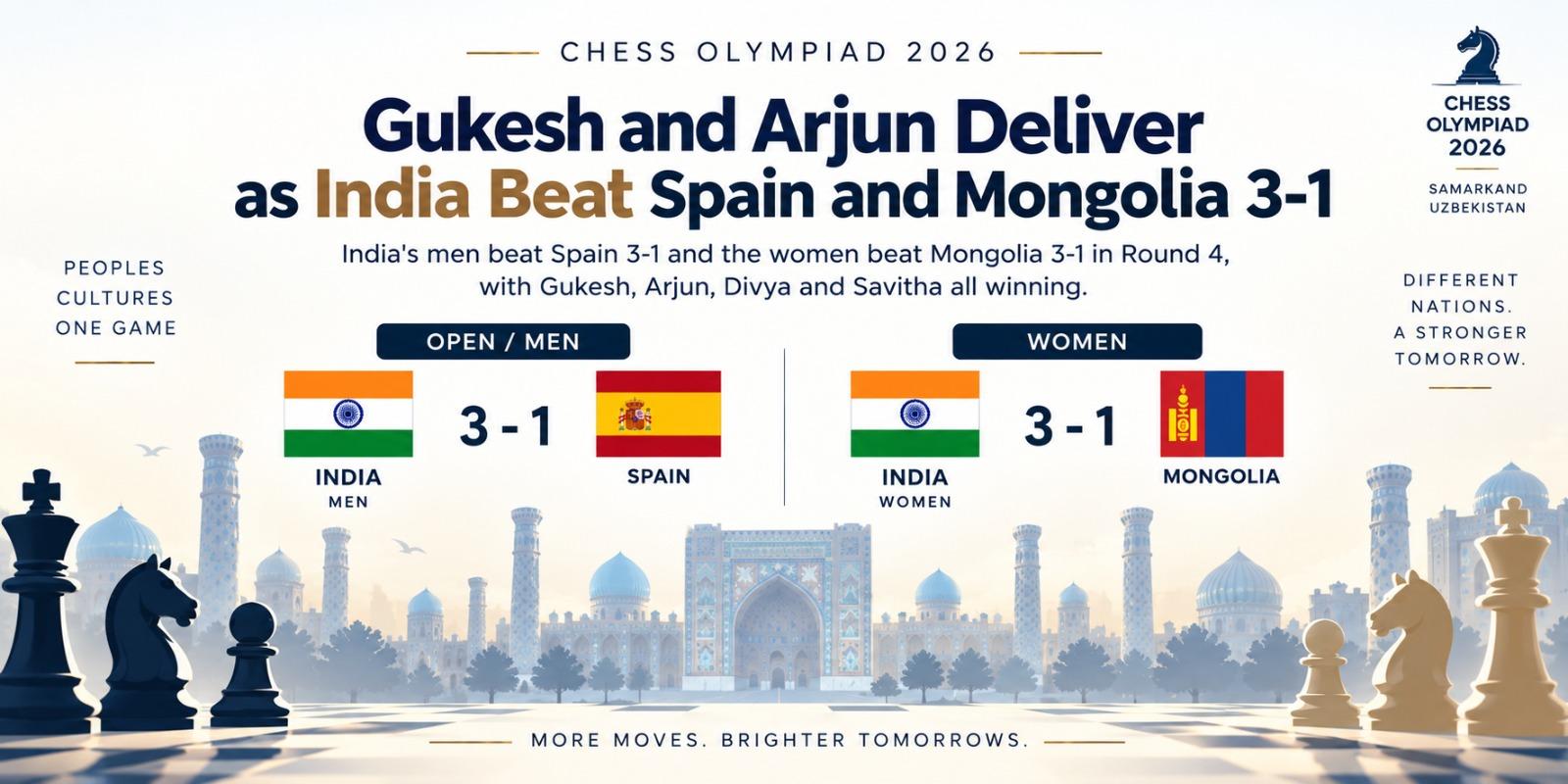
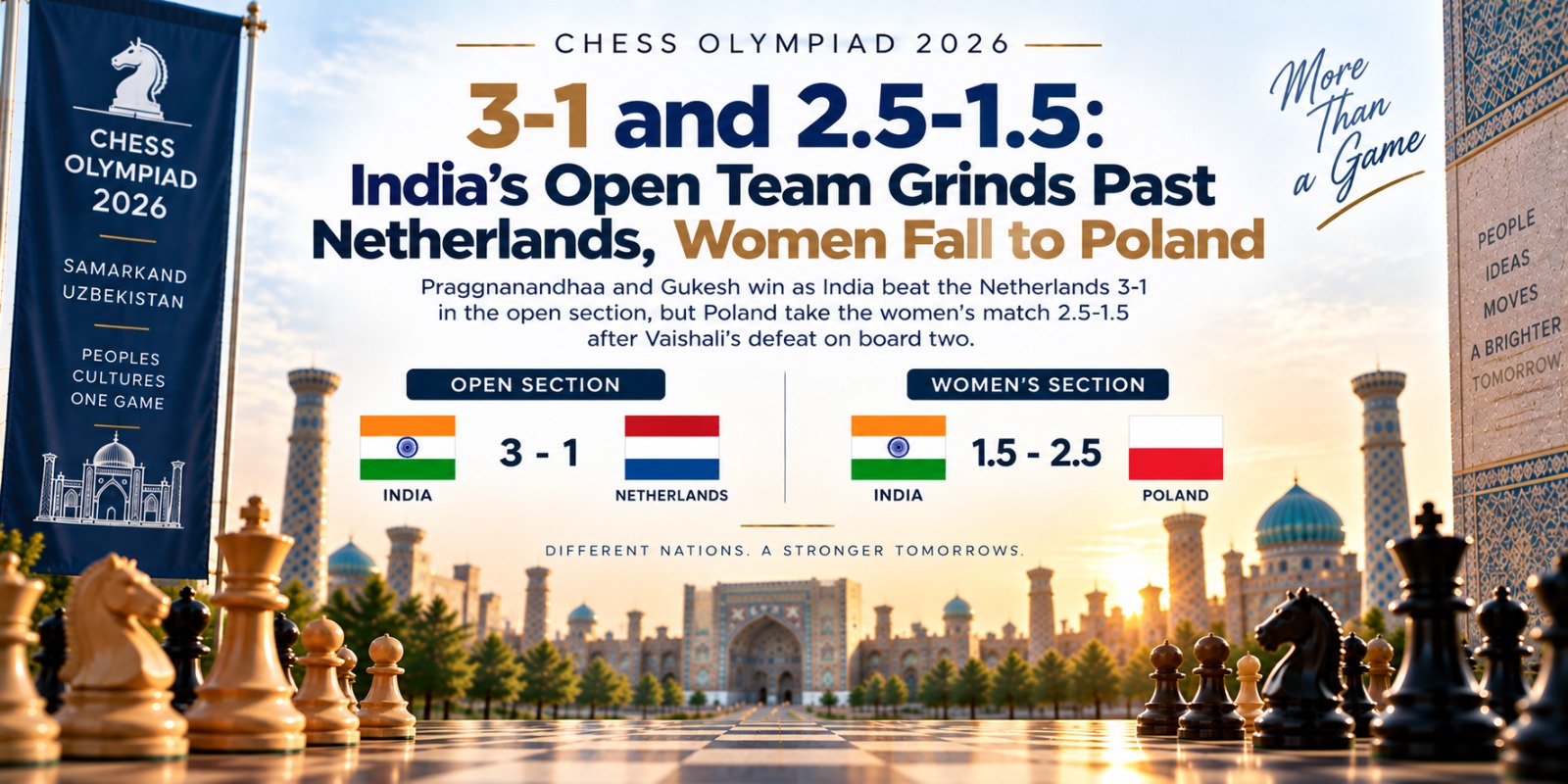
India beat the Netherlands 3-1 in the open section of the Chess Olympiad 2026 round 5, while Poland beat India 2.5-1.5 in the women's section. The two matches swung on different boards and different errors, and the analysis below follows each one from first move to last.
Praggnanandhaa outlasted Anish Giri in a 58-move Ruy Lopez, and Gukesh converted a queen endgame against Erwin L'Ami after the Dutchman's pawn race went wrong. In the women's match, Vaishali resigned three pawns down on board two, and that single loss decided the match.
Board 1: Praggnanandhaa vs Giri, 58 Moves and One Missed Pawn Push
Praggnanandhaa chose the Ruy Lopez with 5.d3 against Giri's Morphy Defense, a quiet setup that keeps the tension low and the game long. Giri answered with a queenside expansion, and for forty moves neither side could claim more than a small edge.
The first real turning point came at move 36. Giri played 36...Ke8, walking into a position where the engine preferred 36...f5, pushing the pawn to challenge White's center before the king commits. After 36...Ke8, Praggnanandhaa found 37.Bxe4, and the bishop trade on e4 left Giri's king exposed and his pawn structure damaged.
Giri had chances to recover. At move 40, with 40...Kc7, the engine preferred 40...c2, pushing the passed pawn to its seventh rank and forcing White to deal with it immediately. Instead the king stepped to c7, and Praggnanandhaa's 41.Nb4 consolidated. The pawn on c2 fell to 45.Rxc2, and the game turned into a technical endgame where White's rook and knight outplayed Black's bishop.
Praggnanandhaa was not flawless either. His 48.g3 let the engine's preference, 48.Kf1, slip, and his 58.Kg5 was less precise than 58.a7, pushing the passed pawn. But Giri's 57...Bc5, where 57...f6 was stronger, gave Praggnanandhaa the space to close the game out. The final position, after 58.Kg5, was one Giri resigned: White's king was marching in, and the a-pawn was still on the board.
Board 2: Van Foreest vs Erigaisi, a Reversed Grunfeld That Never Caught Fire
Jorden van Foreest opened with 1.Nf3 and 2.g3, steering toward a reversed Grunfeld where White hands Black the center and then attacks it. Arjun Erigaisi accepted the invitation, and after 5...cxd4 and 6...Bc5 the game settled into a symmetrical structure.
Erigaisi pushed his kingside pawns with 14...h5 and 15...h4, gaining space but also creating weaknesses. Van Foreest traded into a queenless middlegame, and by move 28 the position was balanced enough that neither side wanted to risk anything.
The one moment the engine flagged was Van Foreest's 29.Red1, where 29.Rec1 would have kept the rook on a more flexible square. After 29...Rxd1+ and 30.Rxd1, the rooks came off, and the players repeated moves from move 38 onward. The draw was agreed after 40.Kc1, a result that suited both teams at that stage of the match.
Board 3: Nihal Sarin vs Van Wely, a Najdorf That Ended in Repetition
Nihal Sarin went for the sharpest line on the board, the Najdorf Amsterdam Variation with 6.f4. Loek van Wely responded with 6...e5, and the game quickly opened up into a position where both sides had chances.
The critical sequence came around move 14. Nihal recaptured with 14.Bxd4, and Van Wely's knight jumped to e5 with tempo. After 14...Ne5 and the subsequent trades, Black had a slight but real edge.
Nihal traded bishops with 16.Bxe6, a practical decision to relieve pressure, though the engine note points out that trading pieces can also help the opponent improve their remaining ones. Van Wely recaptured with 16...Nxf3+, and the game drifted toward equality. Nihal won the pawn back with 25.Rxe6, and after 26...Rc1+ the players shuffled rooks on the c-file until the draw was agreed after 30.Re2.
Board 4: L'Ami vs Gukesh, a Queen Endgame Where the Pawn Race Went Wrong
Gukesh played the Rossolimo Sicilian with 3...g6 against Erwin L'Ami's 3.Bb5. The game was balanced through the opening, but L'Ami's 23.f4 was the first inaccuracy: the engine preferred 23.Qf3, keeping the queen active. After 23...c3, Black's passed pawn was already causing problems.
L'Ami fought back and reached an endgame where his passed c-pawn looked dangerous. The engine flagged 45.Kd5, where 45.Kd3 was better, and 51.Nd6, where 51.e5 was preferred. But the decisive moment was 52.c7, a blunder that the engine scored as losing on the spot. The correct move was 52.Nc8+, checking the king and keeping the pawn on c6. After 52...Bxf2, Gukesh's bishop took on f2 and the pawn race was over.
Even then L'Ami had one more chance. At move 53, instead of 53.c8=Q, the engine preferred 53.c8=N+, underpromoting to a knight with check. The queen promotion allowed 53...d1=Q+, and Gukesh's new queen decided the game. L'Ami resigned after 53...d1=Q+.
Board 1: Koneru Humpy vs Kiolbasa, a King's Indian Attack That Fizzled
Koneru Humpy played the King's Indian Attack against Oliwia Kiolbasa's 2...Nd7, a flexible setup that keeps Black's structure fluid. The game was balanced from the start, and neither side found a way to create real chances.
After the trade on c4 and the queen exchange, the position was dead equal. Kiolbasa's 9...Be4 traded bishops, and the players shuffled rooks on the c-file from move 24 onward. The draw was agreed after 27.Rc3, with neither side having any winning attempt left.
Board 2: Maltsevskaya vs Vaishali, the Board That Decided the Match
With the other three boards drawn, the women's match came down to this game. Aleksandra Maltsevskaya played the London System against Vaishali's 1...d5 and 2...Nf6, and the game stayed balanced through the opening.
But Vaishali could not convert the small edge. The game opened up after 17...O-O-O, and Maltsevskaya's 25.Re7 gave her active pieces on the seventh rank.
The engine flagged Maltsevskaya's 41.Re2, where 41.Rf2 was preferred, but Vaishali's 41...Rh1 was worse. From there Maltsevskaya's rook and pawns took over. She won a pawn with 42.Rxh6, and after 43.Rf2 and 44.Rh7, her h-pawn was running. Vaishali resigned after 57.Rf6, three pawns down, with Maltsevskaya's h-pawn on h7 and the rook on f6 cutting off the king.
Board 3: Divya Deshmukh vs Kulon, a Neo-Grunfeld That Ended Level
Divya Deshmukh chose the Neo-Grunfeld with 2.d4, 3.g3 and 4.Bg2 against Klaudia Kulon's 1...Nf6 and 2...g6. Kulon responded with 6...c6 and 7...Nbd7, keeping her structure flexible.
Kulon's 13...Qc5 allowed White to simplify favorably, and the engine preferred 13...Qh5 to keep the tension. Later, Kulon's 20...Nf6 was less precise than 20...Nf5, and 22...Bf6 was less accurate than 22...Nxc4.
Divya captured on d6 with 24.Bxd6 and 25.Rxd6, but Kulon's active rooks gave her enough counterplay. After 29...Rc2 and the exchange of rooks, the game reached a rook endgame where neither side could make progress. The draw was agreed after 51...Rb1+, with the position repeating.
Board 4: Socko vs Vantika Agrawal, a Semi-Slav That Ended in Repetition
Monika Socko played the Semi-Slav with 5.e3 and 6.Qc2 against Vantika Agrawal's 1...Nf6 and 2...e6. The game was balanced through the opening, and play continued after 19...Qb6 and 20.axb4.
The engine flagged Socko's 14.h3 as an inaccuracy, preferring 14.Nc5 to challenge Black's center. After 14...c5, Vantika equalized. The game simplified into a queenless middlegame, and the players repeated moves from move 29 onward. The draw was agreed after 33.Qd4, with neither side having any winning chances.
What the games tell us is that India's open team won on the boards where it mattered most. Praggnanandhaa and Gukesh both converted long, technical games, and the draws on boards two and three gave India the margin. The women's match went the other way: three draws and one loss, and the loss came on the board where the match was decided. Poland's win was the same scoreline as Budapest two years ago, and this time it came in round five.
For the open team, the 3-1 win over the Netherlands keeps the defending champion on course. For the women, the 2.5-1.5 defeat to Poland is a setback, and the team will need to regroup in the rounds ahead. The games themselves showed that at this level, the difference between a win and a draw is often one pawn push, one king move, one underpromotion.
Final result: India 3-1 Netherlands
Praggnanandhaa R 1-0 Giri, Anish (Board 1)
Van Foreest, Jorden 1/2-1/2 Erigaisi Arjun (Board 2)
Nihal Sarin 1/2-1/2 Van Wely, Loek (Board 3)
L'Ami, Erwin 0-1 Gukesh D (Board 4)
Final result: Poland 2.5-1.5 India
Koneru, Humpy 1/2-1/2 Kiolbasa, Oliwia (Board 1)
Maltsevskaya, Aleksandra 1-0 Vaishali, Rameshbabu (Board 2)
Divya Deshmukh 1/2-1/2 Kulon, Klaudia (Board 3)
Socko, Monika 1/2-1/2 Vantika Agrawal (Board 4)