
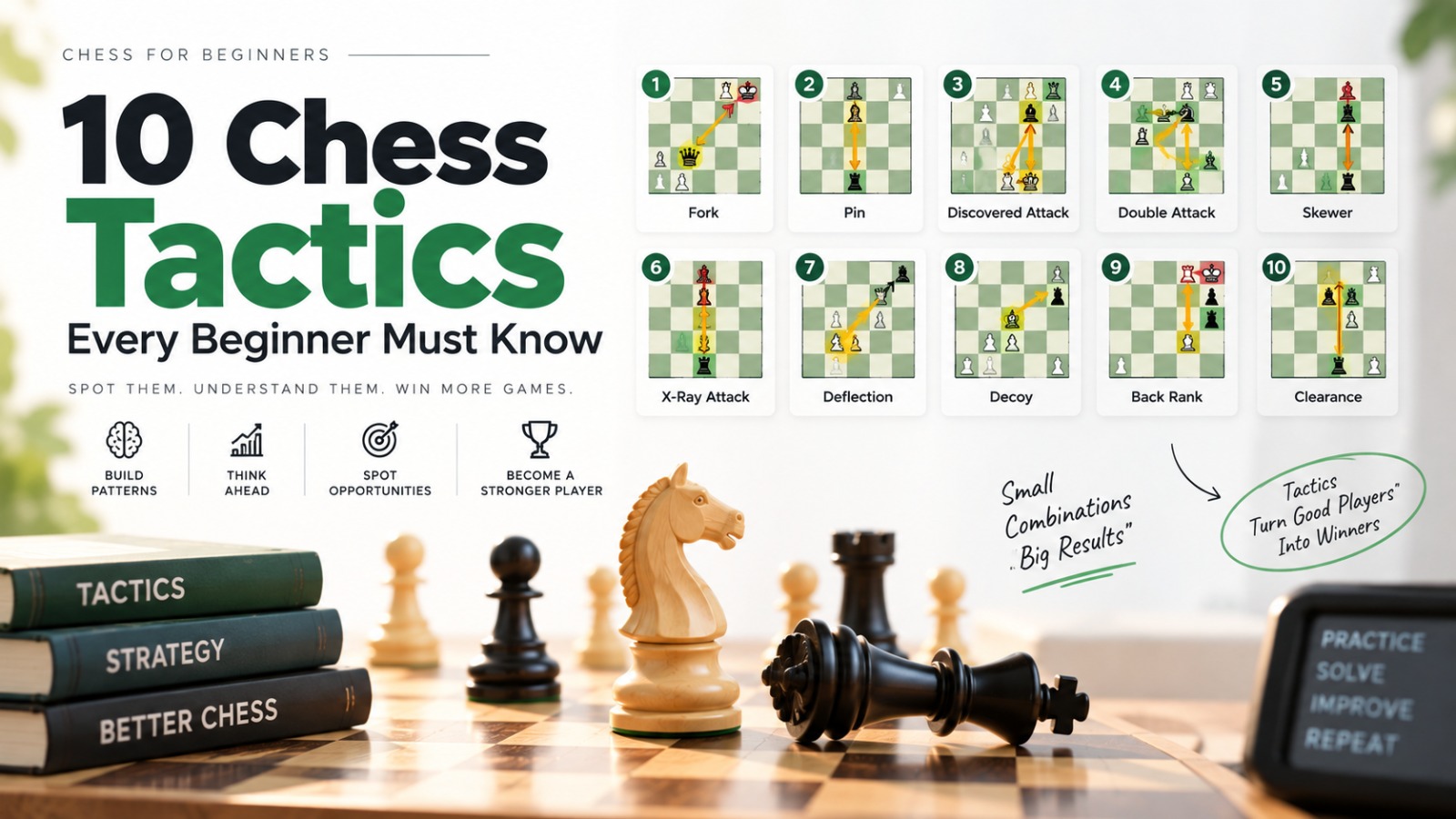
Here's a slightly uncomfortable truth about beginner chess: it's rarely lost because of a bad opening or a weak long-term plan. It's lost in one move, when a piece gets forked, pinned, or left hanging, and the game is effectively over before either player realizes it.
The good news is that tactics are pattern recognition, not talent. The same handful of ideas repeat over and over again, in different disguises, in almost every game played below the master level. Learn to recognize these ten patterns and you will start winning material, and games, that used to slip through your fingers.
1. The Fork
A fork is a single move that attacks two or more enemy pieces at the same time, so that whichever one moves, you win the other.
Knights are the classic forking piece because of their unusual movement, but pawns, bishops, rooks, and queens can all fork too. The most common beginner fork is a knight landing on a square where it simultaneously attacks the enemy king and queen, called a royal fork, which wins the queen outright because the king must move out of check first.
The habit to build: whenever you're about to move a knight, pause and ask what two pieces it would attack from its new square. This single check catches an enormous number of missed opportunities.
2. The Pin
A pin happens when a piece cannot move without exposing a more valuable piece behind it to attack. The most severe version is a pin against the king, called an absolute pin, where the pinned piece legally cannot move at all, because doing so would leave the king in check.
Pins are powerful because a pinned piece is effectively frozen. You can pile up additional attackers on it, safe in the knowledge that it can't run away or capture back in most cases. A very common beginner mistake is forgetting that a pinned piece has lost its defensive value entirely, and playing as though it's still protecting the squares behind it.
3. The Skewer
A skewer is the pin's more aggressive cousin. Instead of a lesser piece hiding behind a more valuable one, a more valuable piece is forced to move, exposing a lesser piece directly behind it to capture.
The classic example is a rook or bishop giving check to a king that has another piece, often a rook, sitting directly behind it on the same line. The king has to move, and the piece behind it falls. Skewers are easy to miss because they often arrive disguised as a simple check, and only become obvious once you notice what's lined up behind the king.
4. The Discovered Attack
A discovered attack happens when you move one piece out of the way, revealing an attack from a completely different piece that was hiding behind it. The moved piece can go almost anywhere, since the real threat comes from the piece left behind.
This is one of the sneakiest tactics in chess because your opponent is often watching the piece you're moving, not the piece you're revealing. The most dangerous version is the discovered check, where moving a piece exposes a check from another piece entirely, forcing the opponent's king to respond while you get to make another threat with the piece you just moved.
5. The Double Attack
Related to the fork but broader, a double attack is any single move that creates two separate threats at once, whether that's attacking two pieces, threatening checkmate while also winning material, or combining a capture threat with a positional demand.
The reason double attacks work so well is simple: your opponent gets one move to respond, and one move can usually only address one threat. If you can consistently create positions where your move does two things at once, you put your opponent in a losing bind far more often than a single-purpose move ever could.
6. Removing the Defender
Sometimes a piece is protected, and the only way to win it is to eliminate whatever is protecting it first. This tactic, often called removing the defender or deflection, involves capturing, trading off, or forcing away the piece that's doing the defending, so the piece it was guarding becomes free to take.
A simple example is trading off a knight that's the only piece defending a pawn, then capturing that pawn on the next move. It sounds obvious once explained, but in the middle of a game, it's easy to focus on the piece you want and forget to ask what's actually keeping you from taking it.
7. The Overloaded Piece
An overloaded piece is a defender that's responsible for guarding two things at once. If you can force it to deal with one of those responsibilities, the other one is left completely undefended.
This tactic shows up constantly in rook and queen endgames, where a single rook is often defending both a back rank checkmate and a hanging pawn at the same time. Learning to spot which of your opponent's pieces is doing too much work is one of the fastest ways to find tactics that aren't immediately obvious on the board.
8. Back Rank Mate
This one catches players at every level, not just beginners. If a king is castled behind a wall of its own pawns that haven't moved, and there's no piece guarding the back rank, a single rook or queen sliding down that row can deliver checkmate, because the king has nowhere to escape to.
The fix is simple and worth building into a permanent habit: once your king is castled, make a small mental note to create an escape square for it, usually by moving one of the pawns in front of it forward one square, sometime before the endgame arrives. That one small move prevents an entire category of tactic from ever being possible against you.
9. The Zwischenzug (In-Between Move)
This is a more advanced idea, but beginners run into it constantly without knowing its name. A zwischenzug, German for "in-between move," happens when, instead of making the expected recapture or response, a player inserts a completely different move first, usually a check or a strong threat, before dealing with the original situation.
The danger for beginners is assuming that after a piece is captured, the only sensible response is to recapture immediately. Strong players constantly ask whether there's a more urgent move available first, one that changes the situation in their favor before the expected sequence continues.
10. The Sacrifice for Attack
Not every tactic is about winning material immediately. Sometimes the strongest move is giving material away on purpose, to rip open the position around the enemy king or to gain enough time and initiative that the material comes back with interest a few moves later.
This is the hardest tactic on this list to calculate correctly, because it requires seeing further ahead than the other nine. But even at a beginner level, it's worth learning to recognize when a king looks exposed and asking whether a temporary sacrifice, giving up a knight or a pawn to tear open the position, might create threats too dangerous for the opponent to handle.
How to actually build these patterns into your game
Reading through this list once will not make these tactics show up for you over the board. Pattern recognition in chess is built the same way it's built in any other skill: repetition, in realistic conditions, over a long period of time.
The single best method is daily tactics puzzles, ideally on a site or app that tracks your rating and adjusts difficulty automatically. Aim for quality over quantity. Ten focused puzzles a day, where you genuinely try to calculate before guessing, will do far more for your chess than fifty puzzles rushed through on autopilot.
It also helps enormously to review your own losses specifically looking for these ten patterns. Ask honestly: was there a fork I missed? Did I forget my rook was pinned? Was my back rank ever actually safe? Most beginner losses fall cleanly into one of these ten buckets, and once you start recognizing which ones keep catching you personally, you can focus your practice exactly where it matters most.
The takeaway
Chess feels overwhelming at the beginner stage because it seems like there's an infinite number of things that could go wrong on any given move. In reality, the vast majority of tactical losses below a certain level come from a small, repeatable set of patterns, the ten covered here. Learn to spot them, build the habit of checking for them before every move, and you'll find yourself winning positions that used to feel like they came out of nowhere.