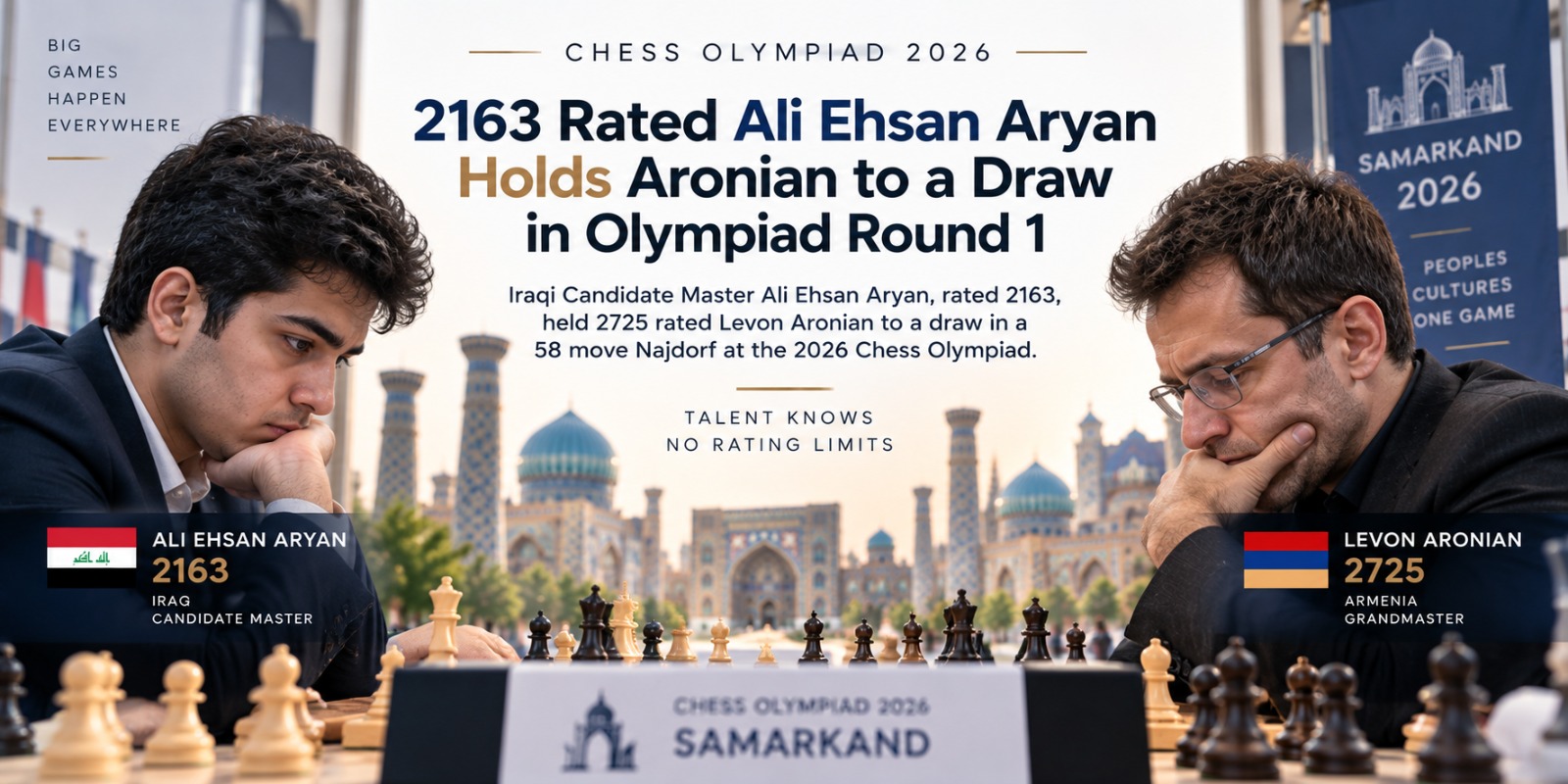
On the top boards of the 2026 Chess Olympiad Open section, a 2163 rated Candidate Master from Iraq named Ali Ehsan Aryan held 2725 rated Grandmaster Levon Aronian to a 58 move draw in a Sicilian Najdorf. The result sent a jolt through the playing hall and immediately became one of the talking points of round 1.
Aryan, representing Iraq, faced the former World Cup winner and longtime world number two with the white pieces in a Zagreb Variation. What followed was a well played, technically sound game in which Aryan traded down into a favorable structure, then held a slightly worse position and a pawn down rook endgame with precise, patient defense.
Aryan vs Aronian: The 562 Point Gap That Did Not Matter
Aryan opened with 1.e4 and Aronian replied with the Sicilian. The game quickly transposed into a Najdorf with 6.g3, a solid setup that avoids the sharpest theoretical lines. Aronian chose 7...Be6 and 12...Qb8, typical Najdorf regrouping moves, and the position stayed close to balanced through the opening, with the engine never showing more than a small, ordinary edge for White.
The key strategic moment came on move 16, and it is worth being precise about what actually happened. Nd5 was not a piece sacrifice. Aryan offered an even trade, knight for bishop, and Aronian accepted it with 16...Bxd5, after which Aryan simply recaptured with the pawn on 17.exd5. Material stayed completely level throughout. What Aryan won from the exchange was structural: a strong, pawn protected outpost on d5 that restricted Black's pieces for the rest of the middlegame, along with the bishop pair. It is a common and entirely sound positional idea in Najdorf structures, not a gamble.
From there, the game stayed close to balanced rather than swinging wildly. 18.c4 followed up naturally, fixing the structure and preparing to open lines on the queenside, and Aronian met it with 18...Ba5, keeping his pieces active. A long sequence of trades followed, queens came off the board by move 32, and the position settled into a rook endgame where Aronian eventually emerged a pawn up.
This is where Aryan's result was actually earned. Rather than defending passively, his king marched forward, from the back rank all the way up the board, while his rook stayed active rather than tied down to defense. That combination of an active king and an active rook is the classic recipe for holding a pawn down in a rook ending, and it is exactly what kept Aronian from ever finding a way through. By move 58, with Black's winning attempts exhausted, the players agreed to a draw.
For Aronian and the United States team, the draw was a minor setback in a long tournament. For Aryan and Iraq, it was a genuine result to be proud of, not because he pulled off some desperate save, but because he played a clean, technically sound game from a normal position and defended a difficult ending with real precision. Round 1 of the 2026 Chess Olympiad delivered plenty of upsets built on blunders elsewhere in the field. This one was built on solid chess, and that makes it worth remembering for the right reasons.