
Almost every game a beginner loses is decided in the first ten moves, long before either player realizes it. A king gets stuck in the center, a piece gets developed twice while the opponent brings out three, or the center gets handed away for nothing. None of that requires a blunder. It just requires not knowing what the first few moves are actually trying to accomplish.
The good news is that beginners do not need to memorize an encyclopedia of chess openings. They need to understand a few reliable ideas, choose a small repertoire, and learn how those openings lead into the middlegame. The best chess openings for beginners are the ones that make good chess principles easy to understand: fight for the center, develop your pieces, protect your king, and reach a playable middlegame without requiring you to remember twenty moves of theory.
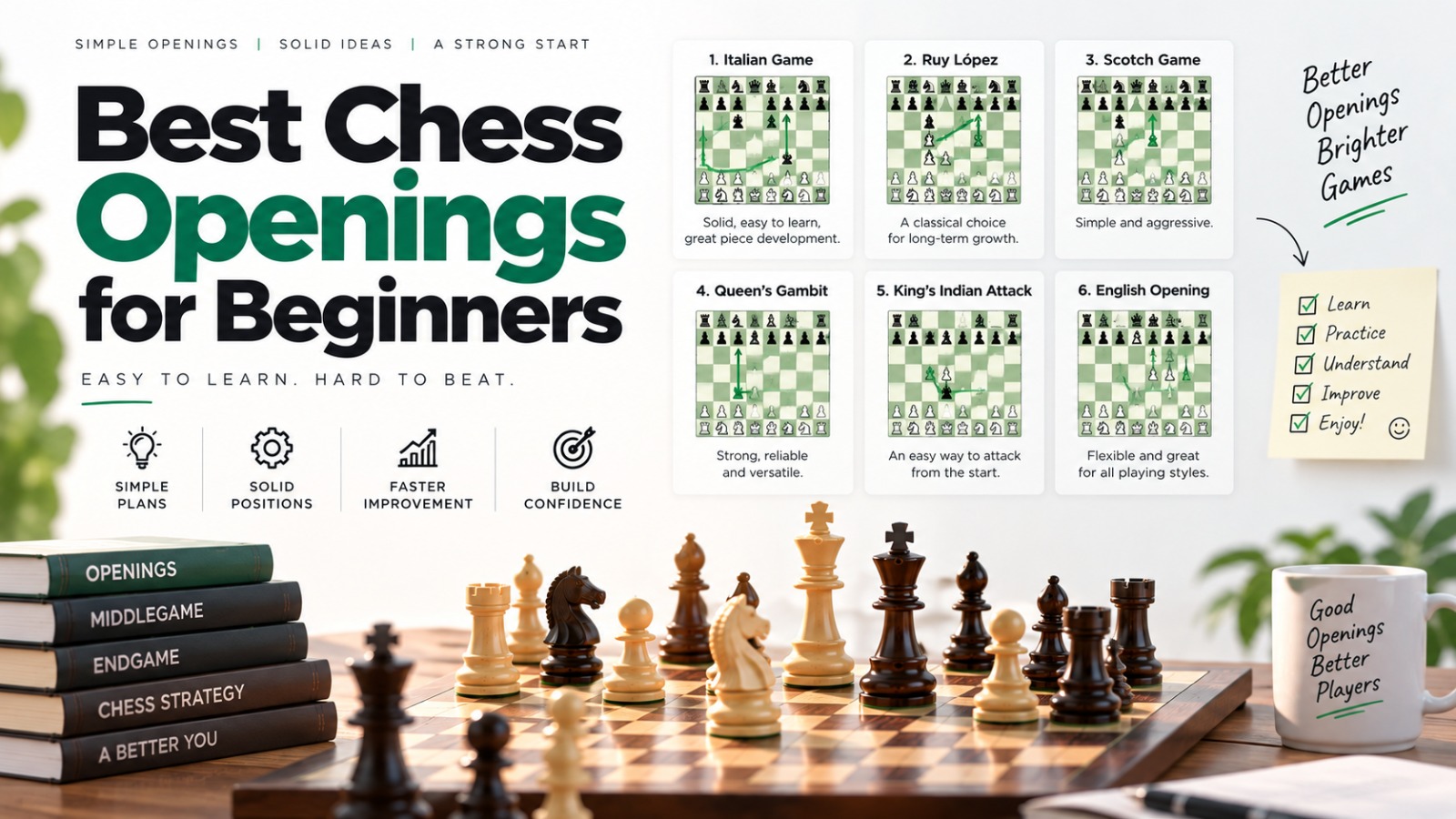
In this guide, we will look at the best chess openings for beginners with both White and Black. Every opening includes an interactive chess board so you can step through the moves yourself, plus a static diagram of the key position and a lesson explaining the main idea. You will learn what to play after 1.e4 and 1.d4, which defenses are easiest to understand, and how to build an opening repertoire without getting trapped in memorization.
What Makes a Chess Opening Good for Beginners?
A beginner-friendly opening is not necessarily the one that gives the highest theoretical advantage. At this stage, the most useful opening is one that helps you understand what your pieces are trying to accomplish. A good beginner opening usually has four characteristics:
1. It follows sound opening principles. You should be fighting for the center, developing your pieces, and getting your king to safety.
2. It has understandable plans. After the opening moves, you should have some idea where your pieces belong and what you are trying to achieve.
3. It does not require excessive memorization. Beginners benefit much more from understanding recurring positions than from memorizing long theoretical variations.
4. It gives you useful chess experience. The best opening is one that teaches you patterns you will continue to use as you improve.
The Three Most Important Opening Principles
Before learning opening names, learn the three jobs that almost every sound opening is trying to accomplish. Chess.com and Lichess both emphasize these as the foundation of good opening play.
1. Control the Center
The central squares are e4, d4, e5, and d5. Controlling these squares gives your pieces more room and makes it easier to move them from one side of the board to the other. That is why 1.e4 and 1.d4 are such important first moves. Both immediately challenge the center while opening lines for your pieces.
You do not always have to occupy the center with pawns. You can also control it with pieces. What matters is that you do not allow your opponent to build a completely free central position.
2. Develop Your Pieces
Development means bringing your knights, bishops, and eventually your other pieces into active positions. A useful rule for beginners: develop the minor pieces before spending too many moves on the queen or moving the same piece repeatedly. Knights often come out early because they can immediately influence central squares. Bishops usually follow once the central pawns have moved enough to give them useful diagonals.
3. Get Your King Safe
Castling is one of the most important opening goals. It moves the king away from the center and brings a rook toward the middle of the board. For beginners, castling early is usually a very good habit, although the exact timing depends on the position.
The Best Chess Openings for White
White has the first move, so you have the opportunity to choose the type of game you want. If you are a complete beginner, the most useful choices are the Italian Game, London System, and Scotch Game.
1. The Italian Game
Starting moves: 1.e4 e5 2.Nf3 Nc6 3.Bc4
If you want one opening to start your chess journey with, the Italian Game is one of the strongest choices. The reason is not simply that the opening is popular. It is because almost every move teaches a useful chess principle. White plays 1.e4 to fight for the center, develops the knight with 2.Nf3, and brings the bishop to c4 where it aims at f7, the weakest square near Black's king.
The Italian Game is particularly valuable for beginners because it teaches development, central control, king safety, tactics, and attacking ideas in positions that occur again and again. From here, White plays 4.c3 to prepare a central push with d4, develops the remaining pieces, and decides whether to play for a quiet positional game or a more tactical battle.
Best for: Beginners who want to learn classical chess principles and improve their tactical understanding.
Main idea: Develop quickly, control the center, castle, and build pressure toward Black's kingside.
2. The Ruy Lopez (Spanish Opening)
Starting moves: 1.e4 e5 2.Nf3 Nc6 3.Bb5
Named after a 16th-century Spanish bishop who wrote one of the earliest known texts on chess theory, the Ruy Lopez has been the choice of nearly every world champion at some point. It is subtler than the Italian Game because 3.Bb5 does not attack anything directly. Instead, it pins Black's knight on c6 to the king behind it, applying long-term pressure on the e5 pawn.
Black almost always asks the question immediately with 3...a6, and after 4.Ba4 the bishop retreats but keeps the pin. The resulting positions teach patience: instead of forcing tactics immediately, White accumulates small advantages move after move.
Best for: Beginners ready to grow into intermediate chess who want to learn positional play and patience.
3. The Scotch Game
Starting moves: 1.e4 e5 2.Nf3 Nc6 3.d4
The Scotch Game is an excellent choice if you prefer an open and active position. Instead of slowly building pressure, White challenges Black's central pawn immediately with 3.d4. The center can open quickly, giving the pieces more lines and creating tactical opportunities.
This makes the Scotch particularly useful for beginners who want to learn how open positions work. You will have to think about development, exchanges, king safety, and tactical threats from an early stage.
Best for: Beginners who enjoy active positions and tactics.
4. The London System
Typical setup: 1.d4, followed by Bf4, Nf3, e3, and often c3.
If the Italian Game and Ruy Lopez feel like too much to keep track of, the London System is the answer. White plays almost the same setup against nearly anything Black tries. The great attraction for beginners is consistency: you are learning a recurring setup rather than memorizing a completely different position every time Black changes move order.
However, the London should not become an excuse to play the same moves automatically. Black can challenge White's center in several ways, and you still need to understand when to react to your opponent's plans.
Best for: Beginners who prefer solid positions and a repeatable setup.
5. The Queen's Gambit
Starting moves: 1.d4 d5 2.c4
Despite the name, the Queen's Gambit is not really a sacrifice. If Black captures on c4 with 2...dxc4, White regains the pawn a few moves later once the position opens up. The real point of 2.c4 is to challenge Black's center immediately and force a decision: accept the pawn and hand White extra central influence, or decline it and contest the center directly.
The Queen's Gambit teaches central control and long-term planning better than almost any other opening, which is exactly why it has stayed popular from club level all the way to World Championship matches for well over a century.
Best for: Beginners moving toward intermediate chess who want to learn positional play.
6. The Four Knights Game
Starting moves: 1.e4 e5 2.Nf3 Nc6 3.Nc3 Nf6
The Four Knights Game is another useful opening for beginners because both sides develop naturally. White develops both knights, Black develops both knights, and both players compete for central control before deciding how to shape the position.
Best for: Beginners who want a straightforward classical opening.
What Should Beginners Play Against 1.e4?
Playing White is only half the problem. Eventually, someone will play 1.e4 against you, and you need a response. The most useful beginner choices include the Caro-Kann Defense, French Defense, Scandinavian Defense, Sicilian Defense, and the classical 1...e5.
7. The Sicilian Defense
Starting moves: 1.e4 c5
The Sicilian is the single most popular reply to 1.e4 at every level of chess, because it immediately unbalances the position instead of mirroring White with 1...e5. Black does not have to play passively just because White moved first.
The Sicilian demands more comfort with sharp, asymmetrical positions than a mirrored defense would, but it teaches an important lesson early: Black does not have to play passively just because White moved first.
Best for: Beginners who enjoy sharp, tactical fights and asymmetrical positions.
8. The Caro-Kann Defense
Starting moves: 1.e4 c6 2.d4 d5
For players who want a solid, low-risk reply to 1.e4 without the sharpness of the Sicilian, the Caro-Kann is one of the most respected defenses in chess. Black prepares 2...d5 without blocking in the light-squared bishop the way the French Defense does.
The resulting positions are solid and slightly passive, but very hard for White to attack head-on, which makes the Caro-Kann an excellent choice for beginners who want fewer forced tactical lines and more long-term strategic understanding.
Best for: Beginners who want a solid defense against 1.e4.
9. The French Defense
Starting moves: 1.e4 e6 2.d4 d5
The French Defense builds a pawn chain with e6 and d5, creating a very solid structure in exchange for a temporary problem: the light-squared bishop on c8 can become difficult to develop for a while. Understanding that tradeoff is itself one of the most useful lessons a beginner can learn, since no opening move is ever completely free.
Black accepts a slightly cramped position in the opening in return for a firm grip on the center. A very reasonable trade at club level.
Best for: Beginners who enjoy strategic positions and are willing to learn pawn structures.
10. The Scandinavian Defense
Starting moves: 1.e4 d5
For players who want the simplest possible reply to 1.e4 with very little theory to learn, the Scandinavian offers an immediate central challenge. After 2.exd5, Black recaptures with the queen right away, which sounds risky since White can develop with tempo by attacking it, but the resulting positions are simple and easy to play without memorizing long forced lines.
The Scandinavian will not win brilliancy prizes, but it is one of the most reliable, low-maintenance defenses a new player can adopt while building overall board understanding.
Best for: Beginners who prefer direct and straightforward play.
11. The Open Game with 1...e5
Starting moves: 1.e4 e5
You do not need a named defense to play good chess against 1.e4. The classical response 1...e5 is one of the best ways to learn how open positions work. From there, White can choose the Italian Game, Ruy Lopez, Scotch Game, Four Knights Game, and many other systems. This means 1...e5 exposes you to a large variety of positions. Challenging at first, but extremely educational.
Best for: Beginners who want broad experience with open chess positions.
What Should Beginners Play Against 1.d4?
When White begins with 1.d4, Black has many strong choices. For a beginner, it is usually better to choose one dependable system rather than attempt to learn every major response.
12. The Queen's Gambit Declined
Starting moves: 1.d4 d5 2.c4 e6
The Queen's Gambit Declined is a classical answer to the Queen's Gambit. Black supports the d5-pawn with ...e6 and builds a solid central structure. The opening is ideal for learning positional concepts such as pawn breaks, piece development, central tension, and strategic planning.
Best for: Beginners who want to learn classical positional chess.
13. The Slav Defense
Starting moves: 1.d4 d5 2.c4 c6
The Slav Defense is another classical response to the Queen's Gambit. Black supports the d5-pawn with ...c6 while keeping the option of developing the c8 bishop outside the pawn chain. Something the Queen's Gambit Declined does not allow as easily.
Best for: Beginners who want a solid response to 1.d4 and enjoy structured positional games.
14. The King's Indian Defense
Typical setup: 1.d4 Nf6 2.c4 g6 3.Nc3 Bg7
The King's Indian Defense is one of the most famous dynamic defenses against 1.d4. Black often allows White to occupy a large central space and then tries to attack that center later with pawn breaks. It can produce exciting attacking games, but it is more complex than the Caro-Kann or Queen's Gambit Declined.
Best for: Beginners who enjoy attacking chess and are ready for more complicated positions.
What About 1.c4 and 1.Nf3?
Not every good opening begins with 1.e4 or 1.d4. 1.c4 is the English Opening, while 1.Nf3 is the starting point of the Reti Opening and can transpose into many different structures. Both moves are completely respectable. They simply tend to lead to more flexible positions where move orders and transpositions matter.
For a beginner who is still learning the basic principles, 1.e4 or 1.d4 is often easier to understand because the central battle becomes clear immediately. Once you become comfortable with opening fundamentals, 1.c4 and 1.Nf3 are excellent additions to your repertoire.
Which Chess Opening Should a Complete Beginner Learn First?
If you are starting from scratch, you do not need ten openings. A simple repertoire can cover most of your games:
As White: Italian Game
As Black against 1.e4: Caro-Kann Defense or 1...e5
As Black against 1.d4: Queen's Gambit Declined
This gives you a manageable starting point without forcing you to memorize dozens of variations. Chess.com similarly recommends that non-professional players focus on a small number of openings rather than trying to build an enormous repertoire immediately.
Best Chess Openings for Beginners by Playing Style
There is no single opening that is perfect for every beginner. Your personality and preferred style matter.
If you like attacking chess: Italian Game, Scotch Game, Sicilian Defense, King's Indian Defense.
If you like solid positions: London System, Caro-Kann Defense, Queen's Gambit Declined, Slav Defense.
If you like tactical positions: Italian Game, Scotch Game, 1...e5, Sicilian Defense.
If you like strategic chess: Queen's Gambit, Queen's Gambit Declined, French Defense, Ruy Lopez.
If you dislike memorization: London System and other setup-based systems can be attractive, although you should still understand the position rather than play moves automatically.
Openings Beginners Should Not Choose Just Because They Look Tricky
One of the biggest mistakes beginners make is choosing an opening because it contains a famous trap. A trap can win games, but it should not become the foundation of your chess education. If your entire opening strategy depends on your opponent playing one bad move, you may win quickly against another beginner and then struggle badly when that opponent knows the correct response.
The better approach is to learn openings that give you useful positions even when your opponent knows what they are doing. That is why principles matter more than traps. The purpose of an opening is to reach a good middlegame, not simply to win a pawn on move five.
How Many Chess Openings Should a Beginner Learn?
Less than you probably think. A beginner can make substantial progress with one opening as White and one defense against each of the two most common first moves, 1.e4 and 1.d4. You can expand the repertoire later when you understand the resulting middlegames.
Learning ten openings superficially is usually less useful than playing one opening repeatedly and understanding the positions that arise from it. Jumping between five openings every week is the single biggest reason beginners feel like they are not improving. Consistency, not variety, is what turns a memorized sequence of moves into real understanding.
Should Beginners Memorize Opening Moves?
Yes, but only to a point. You should know the basic move order of your chosen opening. You should also recognize common responses and understand the purpose behind the moves. What you should not do is memorize a long variation without understanding why the moves are played.
Suppose you remember that a knight goes to f3 on move two. That knowledge becomes much more valuable when you understand that the knight develops toward the center, attacks e5, and helps prepare castling. Understanding turns memorized moves into usable chess knowledge.
The Biggest Opening Mistakes Beginners Make
Moving the Queen Too Early
Beginners often bring the queen out because it is the most powerful piece. The problem is that the queen can become a target for developing pieces, forcing you to waste additional moves.
Moving the Same Piece Repeatedly
If your opponent develops three pieces while you move one knight three times, you may fall behind in development before the middlegame even begins.
Ignoring King Safety
Keeping the king in the center can become dangerous once the center opens. Castling is often the simplest solution.
Moving Too Many Pawns
Pawn moves should have a purpose. They can control the center, challenge an opponent's structure, or create useful space, but unnecessary pawn moves can create weaknesses and cost valuable time.
Chasing Pieces Instead of Developing
Beginners sometimes spend several moves chasing a knight or bishop around the board. Unless there is a concrete tactical reason, development is usually more important.
Playing an Opening on Autopilot
Knowing the first five moves does not mean you should automatically play them regardless of what your opponent does. Every opening is a conversation. Your opponent's moves change the position, and your plan has to change with it.
A Simple Opening Checklist for Every Game
When you do not remember your opening theory, do not panic. Ask yourself these questions:
1. Who controls the center?
2. Which of my pieces are undeveloped?
3. Can I develop a piece with tempo?
4. Is my king safe?
5. Is my opponent threatening anything?
6. Am I moving the same piece again without a good reason?
7. Can I castle?
8. After development, where should my pieces go?
These questions can save you even when you reach a position that is completely outside your opening preparation.
Best Beginner Opening Repertoire at a Glance
If you want the simplest practical starting point, this is a strong structure:
White: Italian Game
Black vs 1.e4: Caro-Kann Defense
Black vs 1.d4: Queen's Gambit Declined
Alternative White opening: London System
Alternative aggressive White opening: Scotch Game
Alternative Black defense vs 1.e4: 1...e5, French Defense, or Sicilian Defense
Alternative Black defense vs 1.d4: Slav Defense or King's Indian Defense
This is more than enough to begin. The objective is not to know every opening. The objective is to become comfortable reaching good positions.
How to Study Chess Openings as a Beginner
Do not spend your entire study session memorizing moves. Instead, study each opening in five stages:
First, learn the basic move order. Know how the opening begins. Use the interactive boards in this guide to step through each one.
Second, learn the purpose of every early move. Ask what each move controls, attacks, or develops. The lesson annotations in each board above explain this.
Third, study typical pawn structures. The pawn structure often tells you where the pieces belong and which pawn breaks matter.
Fourth, study typical middlegame plans. This is where opening knowledge becomes practical chess knowledge.
Fifth, play the opening repeatedly. You will learn much more from seeing the same position twenty times than from memorizing twenty unrelated openings.
Final Verdict: What Are the Best Chess Openings for Beginners?
There is no single opening that magically makes a beginner a strong chess player. The best chess opening is the one that helps you develop good habits and understand the positions you are reaching.
For most beginners, the Italian Game is an excellent first opening with White because it combines central control, rapid development, attacking ideas, and king safety. The London System is a useful alternative for players who prefer a consistent setup, while the Scotch Game is attractive for players who want open and active positions. The Ruy Lopez is the opening to grow into once you are comfortable with the basics.
With Black, the Caro-Kann Defense is a strong beginner-friendly response to 1.e4, while the Queen's Gambit Declined is a classical choice against 1.d4. Players who want more dynamic games can choose the Sicilian Defense or start with 1...e5.
But the most important lesson is bigger than any opening name. Control the center. Develop your pieces. Castle your king. Do not waste moves. Then learn what your opening is trying to achieve.
Once those habits become automatic, opening theory becomes much easier to understand. You stop asking, "What move am I supposed to memorize?" and start asking the much more useful question: "What does this position need?"
That is the point at which learning chess openings stops being memorization and starts becoming chess.