
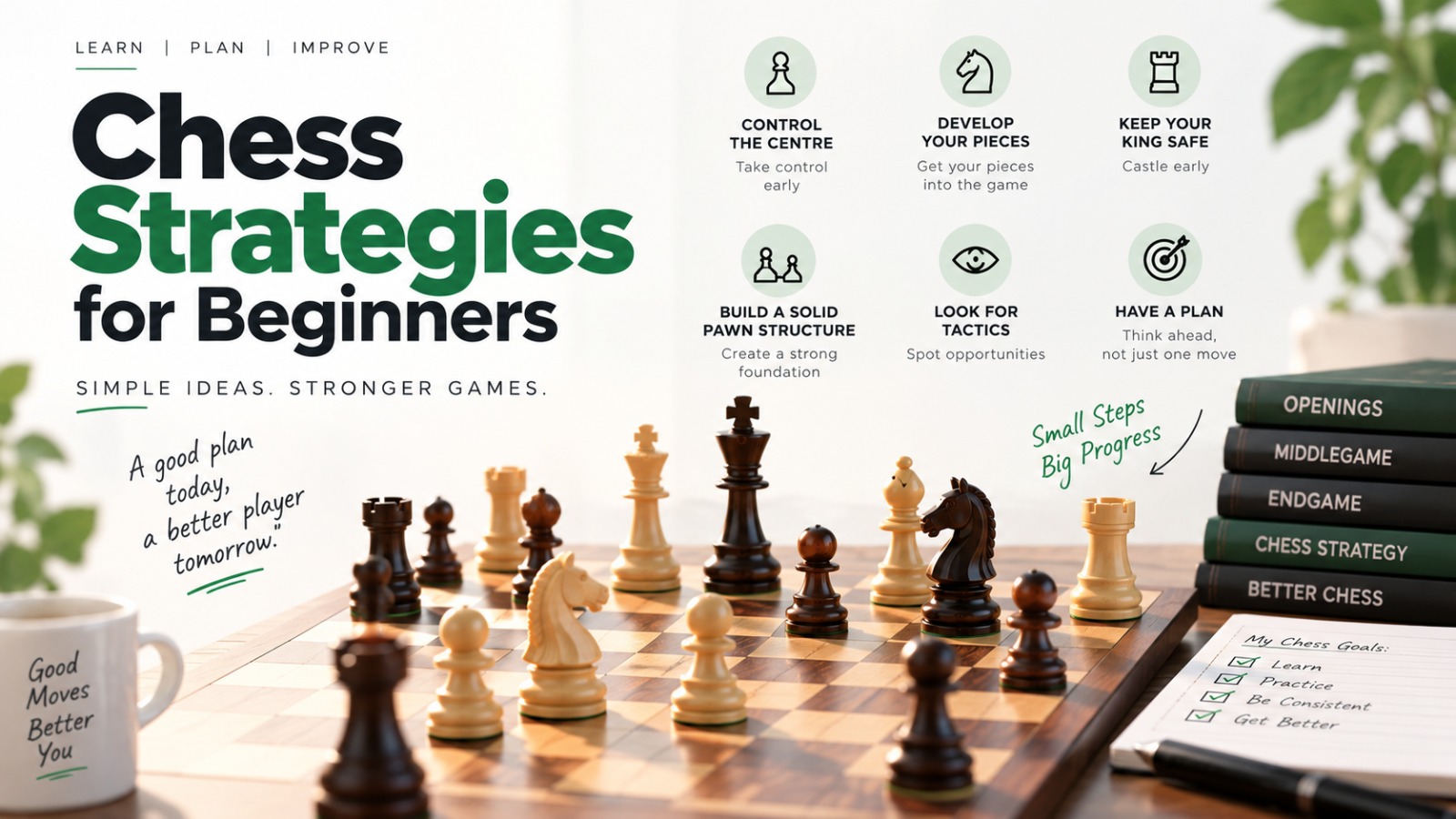
If you've ever lost a chess game and had no idea what actually went wrong, you're not alone, and it's almost never because your opponent found some brilliant hidden move. It's because somewhere in the first ten moves, one side quietly took control of the board and the other side never noticed.
That's the part nobody tells beginners early enough. Chess strategy isn't about memorizing hundreds of moves or being a natural genius. It's a small set of principles, repeated consistently, that decide who's steering the game and who's reacting to it. Learn these principles properly, and you'll start winning games against players who are still relying on instinct alone.
This guide walks through every essential chess strategy for beginners, in the order you'll actually need them, from your very first move to the moment the board starts to empty out.
Why strategy matters more than memorizing moves
New players often assume that getting better at chess means memorizing opening sequences or famous games move by move. That's backwards. Memorized moves fall apart the second your opponent plays something you haven't seen before, which happens constantly at the beginner level.
Strategy is different. It's a set of principles that work in almost any position, regardless of what your opponent does. Once you understand why a move is good, rather than just knowing that it is good, you can make strong decisions in positions you've never encountered before. That's the entire goal of this guide.
1. Control the center of the board
The four central squares, d4, d5, e4, and e5, are the most valuable real estate on the chessboard. A piece placed in the center attacks more squares and has more options than the same piece stuck on the edge. A knight on the rim, as the old saying goes, is dim, and there's real truth behind the cliché.
For beginners, this translates into a simple rule: in the opening, prioritize moves that occupy or control the center with your pawns and pieces. Opening with e4 or d4, and following up by developing knights and bishops toward the middle of the board, gives you more options in every phase of the game that follows. Games are frequently lost simply because one player let the other take the center uncontested in the first five moves.
2. Develop your pieces before you attack
One of the most common beginner mistakes is launching an attack with a single piece, usually the queen, in the first few moves. It feels aggressive, but it almost always backfires, because the opponent can develop normally while chasing your early attacker around the board, gaining time and position with every move.
The stronger approach is development: getting your knights and bishops off the back rank and into active squares before committing to any attack. A good rough guide for beginners is to aim to have most of your minor pieces developed and your king castled within the first eight to ten moves, before starting anything sharp. A well-developed position with your king safe is worth far more early on than a flashy attack with half your army still sitting at home.
3. Castle early to protect your king
King safety is one of the most underrated strategies at the beginner level, largely because it's not exciting. But an exposed king in the center of the board is the single most common reason beginner games end suddenly and decisively.
Castling tucks your king behind a wall of pawns and connects your rooks, two benefits in one move. As a general rule, aim to castle within your first six to eight moves unless there's a very specific reason not to. Delaying castling to grab a pawn or launch a premature attack is one of the most common ways beginners hand their opponent a free, game-ending opportunity.
4. Don't move the same piece twice in the opening
Every move in the opening is a small investment of time, and time in chess, just like in business, is a resource you don't get back. Moving the same piece two or three times in the opening, unless forced to by a direct threat, means you're falling behind in development while your opponent gets extra pieces into the game for free.
A simple habit worth building: before moving a piece you've already moved once, ask whether there's an undeveloped piece that could move instead. More often than not, there is, and it's almost always the stronger choice.
5. Think in terms of threats, not just your own plan
A huge number of beginner losses come from having a great plan and simply not noticing that the opponent's last move created an immediate threat. Strategy isn't only about what you want to do. It's equally about constantly checking what your opponent just threatened to do to you.
Before making any move, get in the habit of asking one simple question: what did my opponent's last move actually threaten? This single habit, checked before every single move without exception, eliminates an enormous percentage of the mistakes that decide beginner games.
6. Don't trade pieces without a reason
Trading pieces isn't automatically good or bad, but beginners often trade without thinking about why. A useful general rule: if you're ahead in material or have a better position, trading pieces usually favors you, since it simplifies the game and reduces your opponent's chances to create complications. If you're behind, avoiding trades and keeping pieces on the board gives you more chances to create the kind of chaos that can turn a losing position around.
It's also worth remembering that not all pieces are equal in every position. A knight might be worth more than a bishop in a closed position full of pawns, while a bishop often becomes stronger once the board opens up. Trading thoughtfully, rather than automatically, is a mark of a player who's starting to understand strategy rather than just following rules.
7. Improve your worst-placed piece
When you're not sure what to do in a position, one of the most reliable strategic questions in all of chess is this: which of my pieces is doing the least right now, and how can I improve it?
This single question turns confusing, quiet positions into clear decisions. Instead of randomly pushing pawns or hoping for a tactic to appear, you're systematically making your whole army more effective, one piece at a time. Strong players return to this question constantly, especially in the middle of the game when there's no obvious tactic or attack available.
8. Don't create unnecessary pawn weaknesses
Pawns can't move backward, which means every pawn move is permanent in a way piece moves are not. Pushing pawns carelessly, especially the ones in front of your castled king, can create long-term weaknesses that a stronger opponent will target for the rest of the game.
Before pushing a pawn, especially near your own king, it's worth asking whether that pawn move creates a hole or weakness that can't be undone later. This is a subtle idea that takes time to fully internalize, but even a basic awareness of it will save beginners from a lot of avoidable long-term trouble.
9. Have a plan, even a simple one
A common beginner habit is playing move by move with no larger direction, simply reacting to whatever the opponent just did. Strong players, even at a relatively modest level, tend to have some kind of plan: attacking on a particular side of the board, targeting a weak pawn, or aiming to trade into a favorable endgame.
The plan doesn't need to be brilliant or original. Even a simple plan, consistently followed, will usually outperform no plan at all, because it gives every move a purpose rather than leaving you to improvise from scratch every single turn.
10. Study your losses, not just your wins
This isn't a strategy for the board itself, but it might be the most important strategy on this entire list for actually improving. Most beginners review their wins for enjoyment and quietly forget their losses. That's backwards. Losses contain almost all of the useful information about what you don't yet understand.
After every loss, take a few minutes to look back through the game and find the moment things started going wrong. Was it a missed threat? A piece left undeveloped? A pawn pushed carelessly? Chances are, it connects directly back to one of the principles above. Reviewing losses with this kind of honesty is one of the fastest ways to turn strategic knowledge into real improvement over the board.
Putting it all together
None of these ten strategies require natural talent or years of study to start using. They require attention and consistency. Control the center. Develop your pieces. Get your king to safety. Watch for threats. Trade with a reason. Improve your worst piece when you're unsure what to do. These aren't tricks or shortcuts. They're the same principles strong players rely on in every single game they play, at every level, for their entire chess lives.
Start applying even three or four of these consistently in your next few games, and you'll likely notice something immediately: you're not just making moves anymore. You're making decisions, with a reason behind each one. That shift, more than any single tactic or opening, is what actually separates a beginner from a genuinely improving chess player.