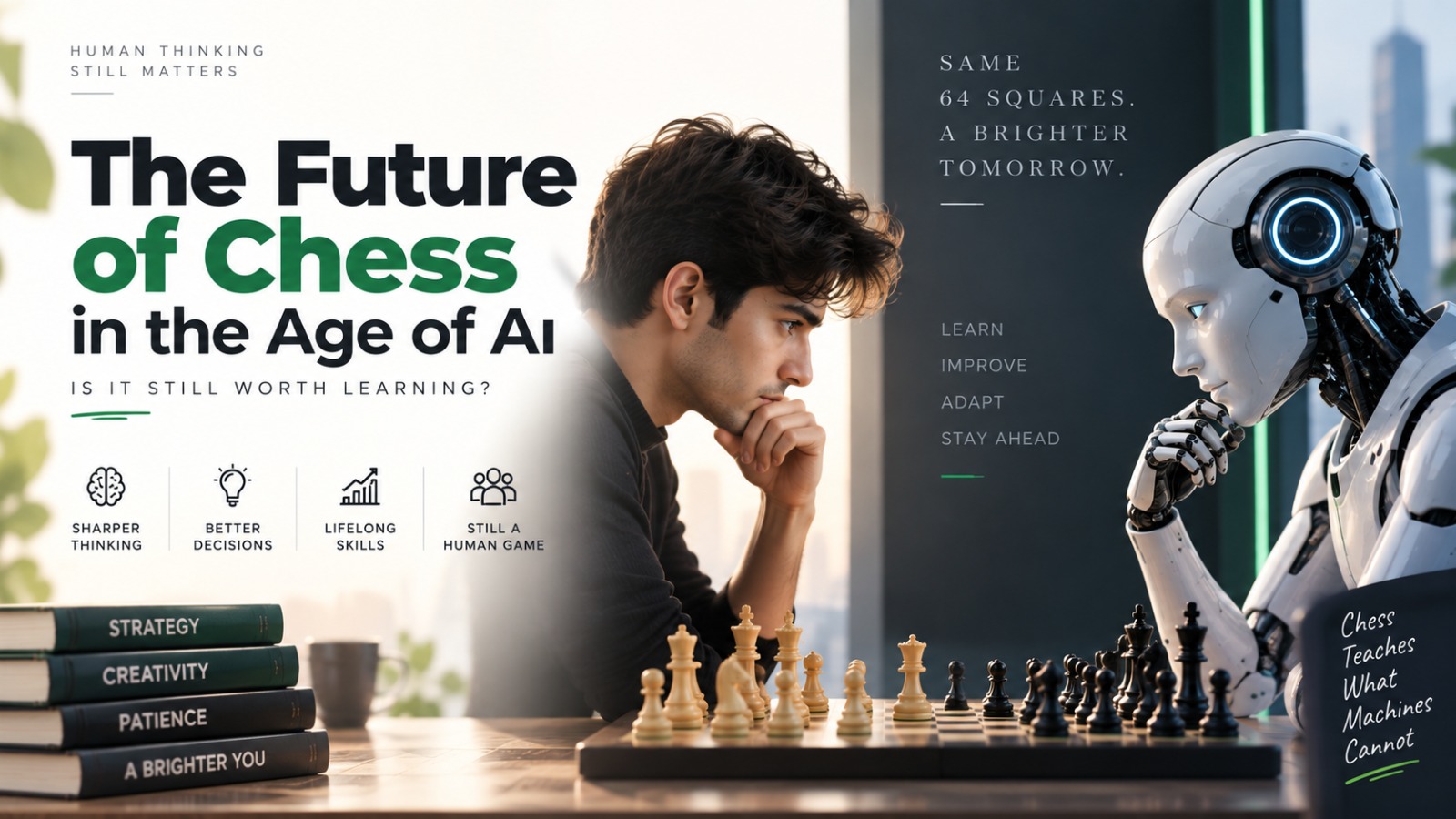
In 1997, a computer beat the best chess player alive. Nearly thirty years later, more people are learning chess than at any point in its history.
If artificial intelligence was supposed to make chess pointless, nobody told the roughly 25 million kids who play the game competitively around the world today, or the tens of millions of adults who picked it up during the pandemic and never stopped. That contradiction sits at the center of a question a lot of parents, students, and curious adults are quietly asking themselves right now: if a computer can already play this game perfectly, is there any real reason left to learn it?
It's a fair question. It also has a more interesting answer than a simple yes or no.
Chess already lost the fight to AI, and it happened decades ago
It's worth being upfront about something. This isn't a new development. The moment a machine became better at chess than any human alive was 1997, when IBM's Deep Blue defeated world champion Garry Kasparov. Since then, the gap has only widened. Today's chess engines aren't just slightly better than the best humans, they're better by a margin so large that a strong laptop program running on modest hardware would beat any human world champion in history in a match that isn't close.
So the "AI is coming for chess" conversation is, in a strict sense, thirty years too late. AI has already won that fight, decisively and permanently. Which makes the current wave of interest in chess even more worth paying attention to, because it's happening in full knowledge that the game has already been mastered by machines. People aren't playing chess because they think they can out-calculate a computer. They never could, even before AI became a mainstream buzzword. They're playing for other reasons entirely, and figuring out what those reasons are is the actual key to answering whether learning chess is still worth it.
What AI actually changed, and what it didn't
It helps to separate two very different things that often get lumped together: playing chess, and understanding chess.
AI has completely transformed how chess is studied. Modern engines can evaluate a position instantly and tell a player exactly where they went wrong, down to the exact move. Neural network based engines have even changed how top grandmasters think about the game itself, popularizing ideas and piece sacrifices that were considered unsound for over a century, simply because the engine calculated that they worked. In that sense, AI hasn't diminished chess. It's deepened it. There are ideas being played at the top level today that no human would have discovered without machine assistance.
What AI has not done is make the human experience of playing chess any less real, difficult, or rewarding. Knowing that a perfect computer exists somewhere doesn't change what happens when two humans sit across a board from each other. The clock still runs. The nerves are still real. The mistakes are still yours to make and learn from. A person learning chess today is not competing against a computer any more than a person learning to run a mile is competing against a car. The comparison was never really the point.
So why is chess more popular now than ever?
A few things happened at once. Online platforms made it possible to play a full game against a stranger anywhere in the world in under ten minutes, at any hour, for free. A hit television show introduced the game to an audience that had never seriously considered it. And a generation of young grandmasters and streamers started broadcasting their games live, turning what used to be a silent, solitary activity into something people watch the way they'd watch a football match, commentary and all.
None of that growth came from people wanting to beat a computer. It came from chess being genuinely fun to play and, increasingly, fun to watch. AI made the analysis tools better and the top-level ideas sharper, but the reason millions of new players picked up the game has almost nothing to do with artificial intelligence at all.
Is it actually worth the time investment?
This is the part where honesty matters more than enthusiasm. The research on chess and cognitive benefits is genuinely mixed, and it's worth saying that plainly rather than overselling it.
Some studies, including long-running research out of Belgium and more recent controlled studies in early childhood education, have found real improvements in attention, memory, logical thinking, and even math and reading scores among children who receive structured chess instruction. Armenia made chess mandatory in its national school curriculum specifically because of results like these, and has documented meaningfully better academic performance among chess-educated students. At the same time, some researchers reviewing the broader body of evidence have pointed out that a lot of the popular claims about chess "making kids smarter" outrun what the data can actually prove, and that more rigorous research is still needed to know exactly which types of thinking chess improves and by how much.
The honest middle ground looks something like this. Chess almost certainly builds real, transferable skills: pattern recognition, planning ahead, weighing multiple options before committing to one, and sitting with the discomfort of a losing position without giving up. Whether it makes a child measurably "smarter" in some general sense is less settled than the slogans suggest. But very few other activities ask a child to sit still, think several steps ahead, take full responsibility for their own mistakes, and try again, all inside a single hour, for free, with nothing but a board and thirty two pieces.
The argument that chess matters more, not less, because of AI
There's a case being made by educators, including the people who built Armenia's national chess program, that chess becomes more important precisely because AI is everywhere now, not less. The reasoning goes like this: as more schoolwork, writing, and problem solving gets outsourced to AI tools, there's a real risk that young people never build the habit of sitting with a hard problem and working through it themselves before reaching for help.
A chessboard doesn't offer that shortcut. There's no autocomplete for your next move. No AI is going to whisper the right answer to a ten-year-old mid-game. Every decision has to be reasoned out, sat with, and owned, wins and losses both. In a world where more and more thinking can be delegated to a machine, an activity that stubbornly refuses to let you delegate any of it starts to look less like a relic and more like exactly the kind of exercise a growing mind actually needs.
What about a future in chess as something more than a hobby?
If the question is whether a child today could realistically compete with an AI, that question was already answered decades ago and the answer is no, nobody can, and that was true before most of today's kids were born. But that was never really the path anyone was pursuing. The realistic paths chess opens up haven't disappeared, they've arguably grown. Competitive over-the-board chess continues to draw serious prize money and sponsorship at the top level. Streaming and content creation around chess has turned some of the game's biggest personalities into full-time careers built on commentary and teaching rather than pure competitive results. Coaching, curriculum design, and chess-in-education work have expanded alongside the sport's renewed popularity. None of these paths require being unbeatable. They require being good, engaging, and willing to keep learning, the same as almost any other skill-based field.
So, is it worth it?
There's no single correct answer here, and anyone claiming certainty in either direction is probably overselling it. What can be said honestly is this: chess was never really a race against a machine, even before AI became a household term. It's always been a way to practice thinking clearly, sitting with difficulty, and taking responsibility for your own decisions on a board that offers no hints and no shortcuts. AI hasn't taken that away. If anything, it's made the case for it a little more interesting, in a world that's increasingly happy to think for you if you let it.
Whether that's worth a few hours a week is a decision every parent and every player has to make for themselves. But it's worth making that decision with the full picture, not the assumption that a smarter machine somewhere makes the human version of the game pointless. It never did.