Here is a question nobody asked out loud for centuries: what if chess had a scoreboard you could actually feel changing in real time?
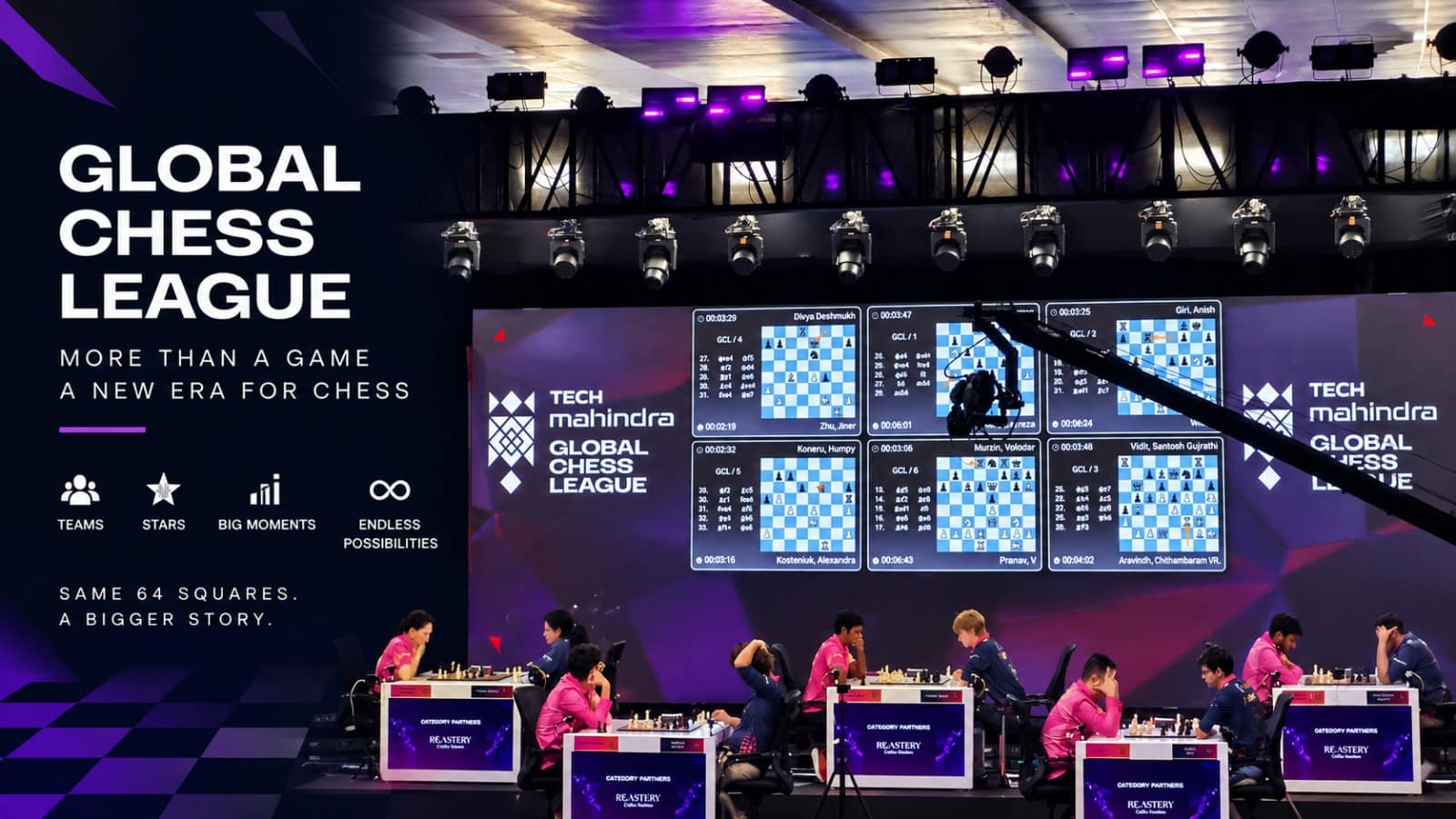
Not a single game between two people at a quiet table, but six games happening at once, under one roof, with a crowd that can watch the entire shape of a match shift in the time it takes to walk from one board to the next. That is the pitch behind the Global Chess League, and it is a stranger, bigger idea than it sounds at first.
Chess has always had an image problem when it comes to spectacle. It is slow, it is quiet, and unless you already understand the position on the board, it can be genuinely hard to know who is winning. The Global Chess League was built to solve exactly that problem, and it did it by rewriting almost everything about how the game is packaged, without changing a single rule of chess itself.
Six players, one team, and a format nobody else in sport uses
Every franchise in the league fields six players at once: an Icon, two Superstar men, two Superstar women, and a Prodigy. All six boards play simultaneously, and the result of the match is decided by adding up what happens across every single one of them.
That single design choice changes everything about how the game feels to watch. A superstar can lose their individual game and still walk away with a match win because a teammate three boards down pulled off something remarkable. A young Prodigy, someone who might be playing their first big tournament in front of a crowd this size, can end up being the reason a franchise wins the whole night.
It is also, by most accounts, the only format in professional sport where male and female athletes compete on the exact same team, chasing the exact same result, rather than in separate divisions. That is not a marketing line. It is baked directly into the roster rules every franchise has to follow.
The scoring system that makes every single move matter
Most sports keep their scoring simple: win the game, get the points. The Global Chess League adds a layer that rewards a very specific kind of courage.
A win with the black pieces, traditionally the harder side to win from in chess, is worth four points. A win with white is worth three. A draw earns each player one point. Add those numbers up across all six boards, and whichever team scores higher takes three match points, with a tie splitting one point each.
The effect of this is subtle but powerful. Players are nudged toward fighting for wins rather than steering games toward safe, spectator unfriendly draws, because the reward for taking the harder path is built directly into the math. It is a small rule with an outsized effect on how aggressively the games get played.
Built by a tech company, not a chess federation alone
The league exists because of an unusual partnership. Tech Mahindra, part of the Mahindra Group, joined forces with FIDE, the International Chess Federation, to build something that neither side could have created on its own. FIDE brought the players, the credibility, and the rules. Tech Mahindra brought the production values, the broadcast ambition, and the belief that chess could be presented the way modern sport is presented, with lighting, commentary, graphics, and pace designed for a television and streaming audience rather than a small room of arbiters.
That partnership shows up in the smallest details. Matches are built for broadcast timing. Player introductions feel closer to a franchise cricket league than a chess tournament. The whole event is engineered to be watched, not just attended.
Around that central partnership sits a group of franchise owners who read like a snapshot of India's business and entertainment world: names tied to steel and infrastructure, sports investment groups, digital media platforms, and engineering conglomerates, each backing a team the way an owner backs a cricket or football franchise elsewhere. Every franchise carries a sponsor's name in its title, which means every match broadcast is quietly also a brand campaign for the companies behind each team.
A league that moves cities on purpose
Since it began, the league has never stayed in one place for long. It started in Dubai, moved to London, then to Mumbai, and has continued to shift its home city with each new season.
That is a deliberate choice, not a logistical accident. A league that plants itself in a new city every season builds a new local audience every season, partners with new sponsors in that market, and generates a fresh wave of local media coverage that a permanently fixed venue simply cannot replicate. It treats the tournament itself as a travelling flagship event, closer to how a major golf tour or a Formula 1 calendar operates, rather than a home-and-away domestic league.
Why a game this old needed reinventing at all
Chess did not need saving. It has never been more popular, thanks in large part to online platforms and a generation of players who grew up streaming their games rather than only writing them down in notation.
What chess needed was a version of itself built for people who love watching sport unfold live, with stakes, rivalries, and a crowd reacting to a move as it happens rather than reading about it the next morning. The Global Chess League did not simplify the game to make it more watchable. It kept every rule exactly as it has always been, and instead redesigned the container the game lives in: the format, the team structure, the scoring, the travelling calendar, and the production around it.
That is a harder thing to pull off than inventing a new game from scratch. It requires respecting something people already love while giving them an entirely new reason to watch it.
The bigger picture
Strip away the sponsors, the cities, and the broadcast graphics, and what is left is still just chess. Two players, sixty four squares, the same pieces that have moved the same way for hundreds of years.
But the experience wrapped around that game has been completely rebuilt, board by board, season by season, city by city. That is the real achievement of the Global Chess League. It did not change chess. It changed what it feels like to watch chess, and in doing so, it gave one of the world's oldest games a genuinely new audience.