Here's something that surprises most club players the first time they hear it: grandmasters don't calculate more moves than you. Often, they calculate fewer.
The myth of the chess genius is that they're seeing twenty moves deep into every position, running the numbers like a supercomputer behind their eyes. That's not what's happening. What's actually happening is more interesting, and far more learnable. Grandmasters have simply gotten extremely good at deciding which moves are even worth calculating in the first place, and at stopping the moment they have enough information to make a decision.
Calculation is a skill, not a talent. It can be trained the same way footwork or a golf swing can be trained. Here is the actual process, broken into pieces you can start using in your very next game.
Step one: Stop calculating everything
The single biggest difference between a strong calculator and a weak one isn't depth. It's filtering.
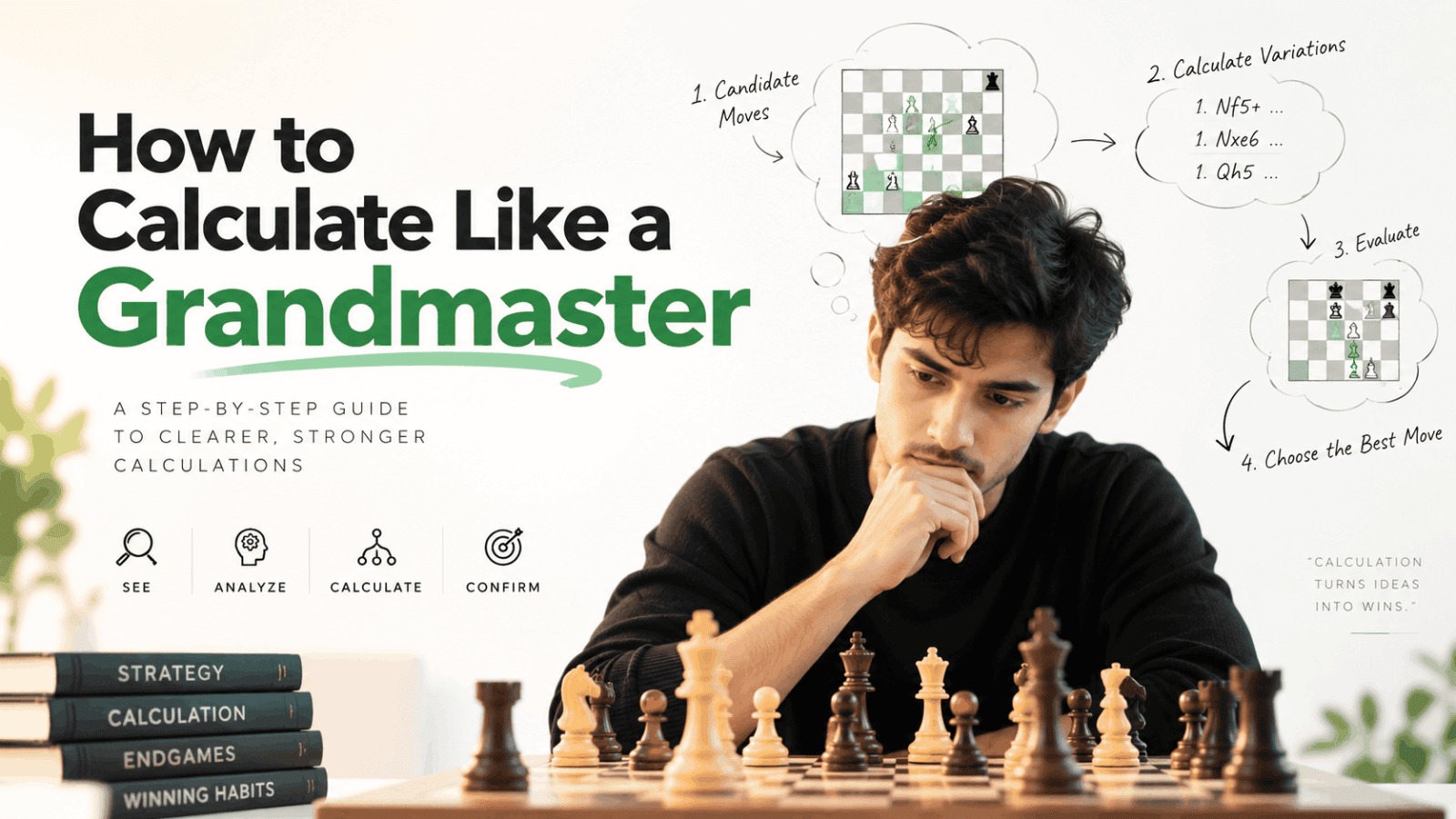
Most players look at a position and try to calculate every move that seems plausible. A grandmaster looks at the same position and immediately narrows the search to what are called candidate moves, usually somewhere between two and four options, and ignores the rest entirely.
A candidate move is any move that creates a real threat, responds to a real threat, or fundamentally changes the character of the position. Checks, captures, and direct threats almost always make the list. A quiet developing move that doesn't change anything urgent almost never does, unless the position is calm enough that long-term planning matters more than tactics.
Before you calculate anything in your next game, force yourself to write down, mentally, your two or three candidate moves before you touch a single one of them in your head. This alone will cut your thinking time in half and improve your accuracy, because you stop wasting mental energy on moves that were never going to be played anyway.
Step two: Calculate forcing moves first, in the right order
Once you have your candidates, the order in which you calculate them matters enormously. Strong players train themselves to always check forcing moves first: checks, captures, and threats, in roughly that order.
The logic is simple. Forcing moves limit your opponent's replies. If you check the opponent's king, they usually have very few legal responses, which means the resulting position tree is small and easy to calculate accurately. A quiet move, by contrast, might allow dozens of reasonable replies, which makes the calculation explode into a mess you can't realistically hold in your head.
This is why so many combinations in chess history follow the same shape: check, check, capture, check, mate. It's not a coincidence or a stylistic preference. It's because forcing sequences are the only sequences a human brain can calculate reliably several moves deep.
Step three: Use the "if, then" method instead of trying to see the whole tree
Weaker players often try to hold an entire branching tree of possibilities in their head at once and get overwhelmed. Strong calculators use a much simpler internal structure: if my opponent plays this, then I play that.
You calculate one line all the way to a concrete conclusion, whether that's winning material, delivering checkmate, or reaching a position you can clearly evaluate. Then you back up to the point where your opponent had a choice, and you calculate their next most dangerous option. You never try to hold every branch simultaneously. You walk down one path at a time, fully, before moving to the next.
This is closer to how a lawyer builds a case than how a computer runs a brute force search. You're not exploring everything. You're following the most testing line to its end, then coming back to test the next most testing one.
Step four: Always calculate your opponent's best move, not their most convenient one
This is where most calculation errors actually happen, and it has nothing to do with depth. Players calculate a beautiful five move combination, feel excited about it, and stop checking as soon as they find one line that works. They forget to ask whether their opponent has a better defense than the one they just calculated.
Grandmasters are relentless about this. After finding a winning line, the next question is always: what is the single most annoying, most resourceful move my opponent could make right here? Not the move that loses fastest. The move that causes you the most trouble. If your combination still works against that move, it's real. If it only works against a weaker reply, it isn't finished yet.
Step five: Know when to stop calculating and trust your judgment
This might be the most underrated skill in all of chess. Calculation has to end somewhere, and knowing where is a skill in itself.
You don't need to calculate to checkmate every single time. You need to calculate until you reach a position you can evaluate with confidence, whether that's a clear material advantage, a won endgame, or simply a position that's obviously better for you even if you can't state exactly why. Trying to calculate every position to a forced, provable conclusion is not just unnecessary, it's often impossible, and chasing it burns clock time you'll need later in the game.
Strong players develop a kind of internal alarm that tells them when they've calculated enough to move with confidence. That alarm is built through repetition, not talent. The more positions you calculate correctly, the faster and more reliably that internal sense develops.
The training method that actually builds this skill
Reading about calculation will not improve your calculation. The only thing that builds this skill is solving positions where you are forced to calculate without moving the pieces.
Here is a simple, proven routine. Take a tactics puzzle, ideally one rated slightly above your comfort level. Set a timer. Do not touch the board or the pieces. Calculate the full line in your head, including your opponent's most testing replies, until you reach a position you can clearly evaluate. Only then, write down or say out loud the entire sequence before checking if you were right.
This single exercise, repeated daily even for ten or fifteen minutes, does more for your calculation than almost anything else you can do. It forces you to hold positions in your head, follow forcing sequences to their conclusion, and check your opponent's best defense, which are the exact three skills covered above.
The real secret
Grandmasters aren't seeing the board differently because their brains work faster. They're seeing it differently because years of this exact process have trained their pattern recognition to instantly flag which moves are worth calculating at all. What takes a club player minutes of conscious searching, a grandmaster's brain does almost instantly, because the pattern has been seen a thousand times before.
That means the gap between you and a grandmaster's calculation isn't a wall. It's a distance, and it's covered one calculated position at a time. Start with the five steps above. Apply them in your next game, slowly and deliberately, even if it feels awkward at first. The speed comes later. The method comes first.