
Most chess openings go in and out of fashion. The Italian Game just refuses to leave.
It was being played in Italy in the fifteen hundreds, it was a favorite of the great attacking players of the nineteenth century, it fell out of favor at the top level for decades because everyone assumed it was too tame, and then it came roaring back once modern grandmasters realized how many ways there are to make the position uncomfortable for Black. If you're a club player looking for one opening you can trust for the rest of your chess life, this is one of the strongest candidates.
This guide walks through the whole system: how it starts, what each side is trying to do, the main branches you'll actually face over the board, and the traps that have been catching players for a very long time.
The starting moves
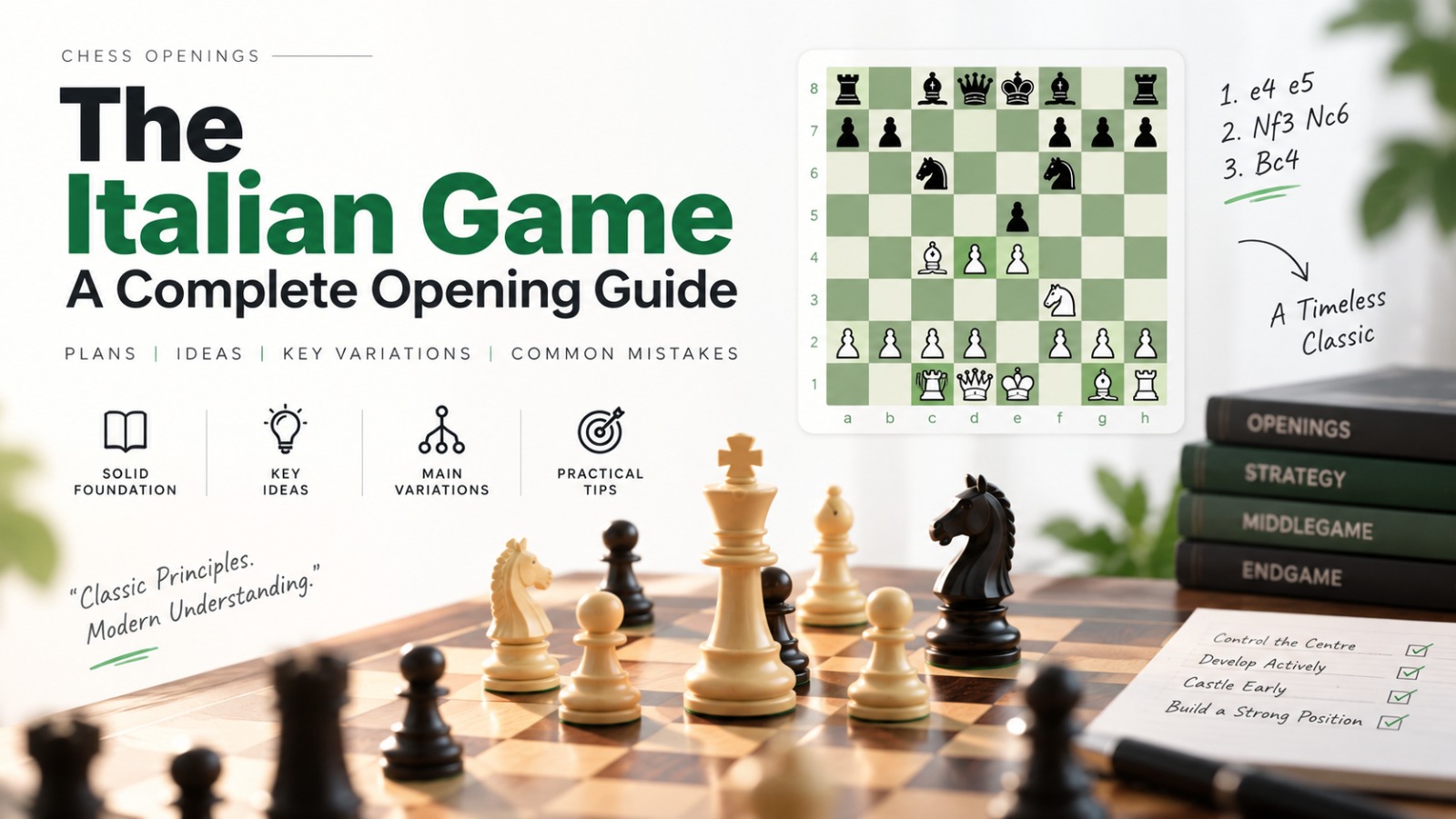
The Italian Game begins:
1. e4 e5
2. Nf3 Nc6
3. Bc4
That's it. Three moves, and you're already in one of the oldest fights in chess. White develops the knight to its most natural square, then brings the bishop out to a diagonal aimed straight at f7, the weakest point in Black's camp in the opening. It's a simple, honest setup, and that simplicity is exactly why it's so good for learning how chess actually works.
Black almost always responds with 3...Bc5, mirroring White's idea and eyeing f2. This is the most common and most solid reply, and it's where the real opening theory begins.
The idea behind the bishop on c4
Before getting into specific lines, it's worth understanding why this bishop placement is so effective. The f7 square is the only square in Black's starting position that is defended solely by the king. Every other pawn near the king has at least one other piece watching it early on. Aim a bishop, and later a knight or queen, at f7, and you create pressure that Black has to take seriously from move three onward.
This single idea explains almost everything that happens in the opening's sharpest lines, including the most famous trap in all of chess.
The main branch: the Giuoco Piano
After 3...Bc5, White most commonly continues 4. c3, preparing to build a strong center with d4. This is called the Giuoco Piano, Italian for "quiet game," though modern play has shown it's anything but quiet once the center opens up.
Black typically replies 4...Nf6, developing and attacking e4, and the position often continues 5. d4 exd4 6. cxd4 Bb4+. This check is important. White has two reasonable responses:
7. Nc3, sacrificing a pawn for rapid development and long-term pressure, known as the Moller Attack.
7. Bd2, offering a trade of bishops and heading for a calmer position with a solid center.
The Moller Attack is the sharper, more ambitious choice. White gives up a pawn temporarily in exchange for a big lead in development and a dangerous initiative against Black's king, which hasn't castled yet. It requires precise play from both sides, but it's an excellent way to learn how to convert development advantages into real threats.
The modern main line: the Italian with c3 and d3
At the highest levels of chess today, many players avoid the sharp tactical battles of the Moller Attack entirely and instead play a quieter, more strategic setup: 4. c3 Nf6 5. d3.
This slower approach has become extremely popular, including among elite grandmasters, because it avoids forcing lines and instead builds a long, comfortable game where White can slowly improve every piece. White typically follows up with Nbd2, O-O, Re1, and often a well-timed d4 push once all the pieces are ready. It's less flashy than the Moller Attack, but it's arguably more dangerous in practice, because it's very easy for Black to play passively and slowly drift into a worse position without ever being hit with an obvious tactic.
This is the version of the Italian Game most worth learning first if your goal is a reliable, long-term weapon rather than forcing lines that require heavy memorization.
The Two Knights Defense: when Black skips the bishop
Instead of 3...Bc5, Black can play 3...Nf6, developing the other knight and inviting a much sharper fight. This is the Two Knights Defense, and it leads to some of the most tactical positions in all of open game chess.
The critical line runs 4. Ng5, attacking f7 directly, and now Black has a choice between two very different approaches. The sharpest is 4...d5, offering a pawn sacrifice to open the position immediately, leading to wild complications after 5. exd5 Na5, where Black chases the bishop and fights for the initiative despite being a pawn down. The other major option is 4...Bc5, the Traxler Counterattack, where Black essentially ignores the threat to f7 and counterattacks immediately, leading to some of the most chaotic, double-edged positions in the entire opening.
If you enjoy sharp, calculation-heavy chess, the Two Knights Defense is worth studying in depth. If you prefer calmer positions, White can sidestep all of this simply by playing 4. d3 instead of the more aggressive 4. Ng5, transposing into quieter territory similar to the modern main line above.
The trap every beginner should know: the Fried Liver Attack
No guide to the Italian Game is complete without the Fried Liver Attack, one of the most famous tactical patterns in chess history. It arises after 3...Nf6 4. Ng5 d5 5. exd5 Nxd5, where instead of the safer 5...Na5, Black recaptures with the knight.
This is a mistake, and White punishes it with 6. Nxf7, sacrificing the knight to drag the black king out into the open. After 6...Kxf7 7. Qf3+ Ke6 8. Nc3, the black king is stuck in the center of the board while White brings every remaining piece into the attack. Black is technically up a piece, but the king safety is so compromised that White's attack is often winning outright with accurate play.
This trap has caught players from beginners to titled masters for well over a century, and understanding why it works, and how to avoid falling into it as Black, is one of the most valuable lessons the opening has to offer.
What each side is really trying to do
Strip away the specific move orders, and the Italian Game comes down to a few clear strategic themes worth internalizing.
White is trying to build a strong pawn center with d4, use the early development lead to create threats before Black can fully organize, and keep constant pressure on f7 and the e-file. Every major branch of the opening, whether sharp or quiet, is built around these same three goals.
Black is trying to challenge White's center quickly, usually with d5 at some point, complete development without falling behind, and neutralize the pressure on f7 before it becomes dangerous. The lines where Black struggles most are almost always the ones where these three things happen too slowly.
Which version should you actually learn
If you're newer to chess, start with the modern quiet setup: c3 and d3, developing normally, and castling early. It requires the least memorization, teaches sound positional principles, and rarely leads to disaster if you forget a specific move order.
If you already enjoy sharp tactical chess and don't mind memorizing forcing lines, the Moller Attack and the Two Knights Defense are both excellent additions once you're comfortable with the basics. They reward calculation and punish passive play severely, which makes them fantastic training tools even if you don't play them in every game.
Why this opening has lasted so long
Openings that survive for centuries usually survive because they teach something true about the game itself, not because a single line has never been refuted. The Italian Game endures because it's built entirely around ideas that never go out of date: fast development, central control, and pressure on the weakest point in the opponent's position. Learn this opening properly, and you're not just memorizing moves. You're learning the fundamental logic that underpins nearly every open game in chess.